Building The Vision · F&I Products
F&I Products for Dealers: Which Ones Actually Drive Profit?
Not sure which F&I products to prioritize? This guide covers the most profitable options for franchised dealers, how to evaluate administrators, and how the right mix builds long-term wealth.
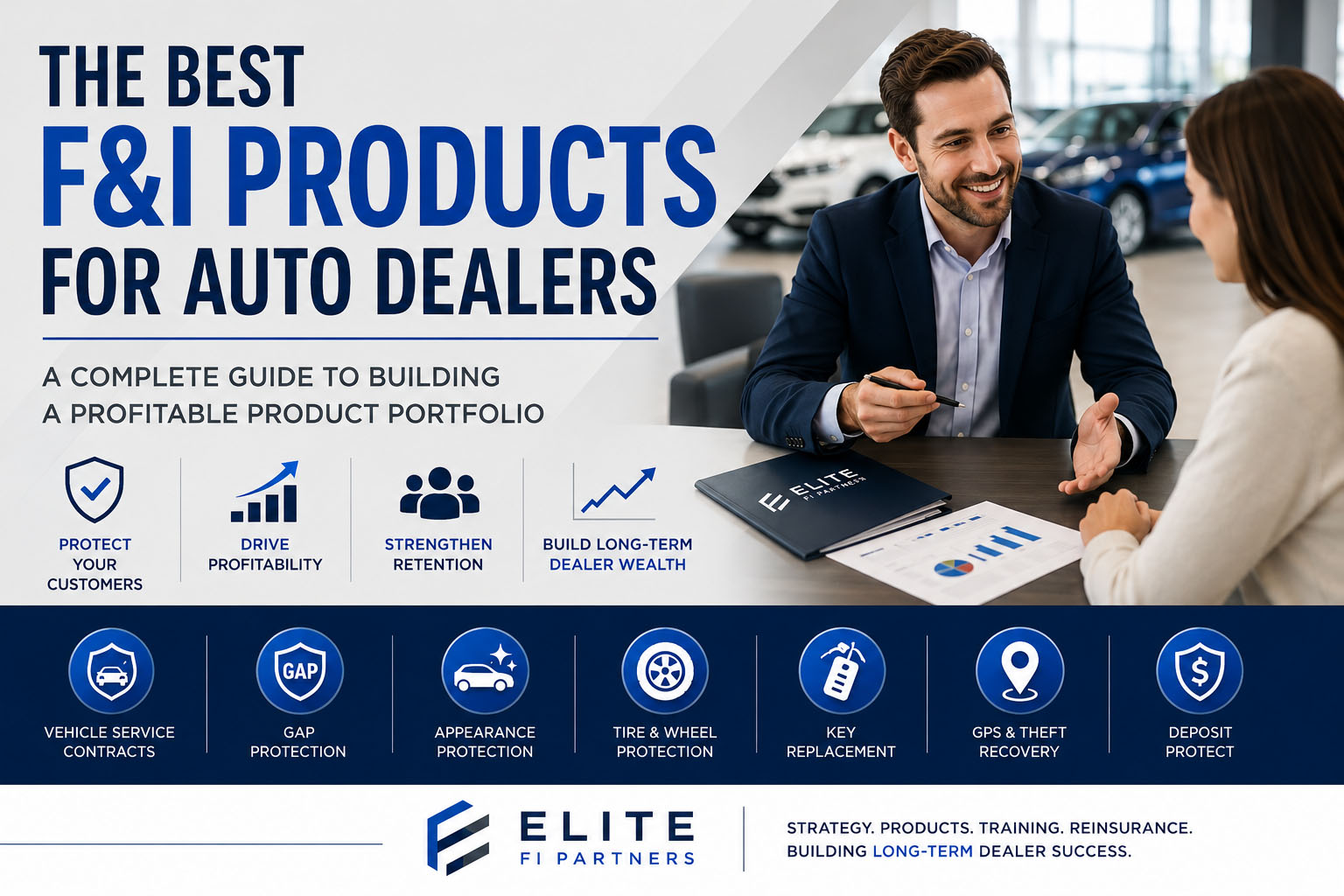
Successful dealerships do not win by selling more products. They win by building an intentional product strategy centered on customer value, profitability, retention, and long-term growth. A finance office that presents the right products, to the right customers, through a consistent process, builds both income and loyalty.
The best F&I products for auto dealers are not a fixed list. They depend on the dealership’s inventory, customer base, financing mix, claims exposure, and business goals. A high-line franchise store and an independent used-car lot serve different buyers with different risks, so their menus should look different.
What are F&I products?
F&I products — finance and insurance products, also called aftermarket or voluntary protection products — are the optional coverages and services a dealership offers alongside the vehicle itself, presented in the finance office after the sale price is agreed.
They exist because a vehicle purchase creates exposures the sale price does not address: mechanical failure after the factory warranty ends, owing more than a total-loss insurance settlement pays, wear that damages resale value, and the cost of replacing things that are expensive precisely because nobody plans for them.
For the dealership they are the back end of the deal — the margin, retention and (through profit participation) long-term wealth that front-end vehicle gross no longer reliably provides.
The main categories
- Vehicle service contracts — mechanical breakdown coverage after the factory warranty, from powertrain through exclusionary
- GAP protection — covers the difference between the insurance settlement and the loan balance on a total loss
- Appearance protection — paint, interior and environmental damage; cosmetic condition rather than mechanical operation
- Tire and wheel protection — road-hazard damage, which is frequent, expensive, and rarely budgeted for
- Key replacement — modern keys cost hundreds to replace, which surprises nearly every customer
- Theft protection and GPS recovery — deterrence plus recovery, increasingly relevant in higher-theft markets
- Prepaid maintenance — scheduled service at a fixed cost, and the strongest service-retention product on the menu
- Deposit protect — protects the customer’s deposit in defined circumstances
Which of these belong on your menu is the actual question, and the answer is not the same for every store. The rest of this guide works through it.
What Makes a Great F&I Product?
Before deciding which products to feature, it helps to define what separates a strong product from a weak one. Great F&I products solve a real customer problem while supporting sustainable dealership growth. When you evaluate any product for your menu, weigh it against these factors:
- Customer value. Does it protect the customer from a real, meaningful cost or risk they actually face during ownership?
- Claims experience. Does the product pay claims fairly and quickly, so customers feel protected rather than denied?
- Administrator quality. Is the company behind the product stable, responsive, and easy to work with for both the dealer and the customer?
- Dealer profitability. Does it contribute durable income without depending on pressure to sell?
- Customer retention. Does it bring the customer back to your service drive or showroom?
- Ease of presentation. Can a finance manager explain the value simply and honestly?
- Compliance. Does it support a transparent, consistent, well-documented process?
- Reinsurance compatibility. Does its claims behavior fit a long-term participation strategy?
- Inventory fit. Does it match the vehicles you actually sell and how customers use them?
- Long-term satisfaction. Will the customer still feel good about the purchase a year later?
A product that scores well across these dimensions earns a place on the menu.
Vehicle Service Contracts Remain the Foundation
For most dealerships, the vehicle service contract is the cornerstone of the finance office. It addresses the single largest unplanned cost of ownership, mechanical repair, and it does so on the vehicles customers most worry about. As repair costs continue to climb and vehicles grow more complex, the value of a well-written contract grows with them.
Modern vehicles are dense with technology. Advanced driver-assistance sensors, integrated electronics, and complex drivetrains are expensive to diagnose and repair. Electric and hybrid vehicles add high-voltage batteries, charging hardware, and electric drive units that a standard contract often excludes, which is why purpose-built EV and hybrid coverage matters as those vehicles reach the used market. High-mileage vehicles, where the factory warranty is long gone, represent another large segment that benefits from coverage written for older units.
Beyond the repair protection itself, a service contract gives the customer peace of mind and gives the dealership a reason to see them again. Every covered repair is a return visit to your service drive, which supports retention and fixed-operations revenue. For commercial buyers, a commercial vehicle service contract protects uptime on vehicles that generate income, a different and often higher-stakes conversation than a retail deal. Across the automotive product shelf, the service contract is usually the anchor everything else is built around.
GAP Protection Still Requires Strategic Thinking
GAP protection addresses the gap between what a customer owes and what insurance pays after a total loss or theft. With longer finance terms, lower down payments, and higher loan-to-value ratios common today, many buyers are upside down for much of their loan, which is exactly the exposure GAP is built for. For the customer, it can prevent owing thousands of dollars on a vehicle they no longer have.
GAP is a high-attach, high-value product, but it still deserves strategic thinking rather than autopilot. Claims performance and market conditions vary, and dealers should evaluate how GAP fits inside their participation strategy based on actual loss experience rather than assuming it always belongs in every program. Presented well alongside the service contract, GAP completes the financial protection story for the customer while contributing meaningfully to finance office performance.
Appearance Protection Creates Long-Term Value
Appearance protection helps customers preserve the look and condition of their vehicle over a long ownership cycle. Paint and clear-coat protection guards the exterior against UV exposure, oxidation, road grime, and environmental fallout. Interior protection helps fabric, carpet, leather, and vinyl resist spills, stains, and everyday wear. For a customer who takes pride in their vehicle, this is tangible, visible value they experience every day.
For the dealership, appearance protection is a high-margin category with strong perceived value, and it supports resale appearance and customer satisfaction. Because the benefit is something the customer can see and feel, it tends to be an honest, easy product to present when it is tied to how the customer actually uses and cares for the vehicle.
Tire and Wheel Protection Continues to Grow in Importance
Tire and wheel protection has become more relevant as wheels get larger, tires get more expensive, and roads stay rough. Road hazards like potholes, debris, and curb damage can ruin an expensive tire or wheel in an instant, and on luxury and performance vehicles the replacement cost is significant. Electric vehicles, which are heavier and often ride on specialized low-rolling-resistance tires, add to the exposure.
For customers, the value is simple and concrete: covered repairs and replacements without a surprise out-of-pocket bill. For dealers, it is a strong ancillary product with predictable claims behavior, which makes it both customer-friendly and a sensible line on a properly structured menu.
Key Replacement Solves an Expensive Problem
Modern key fobs are small computers. Replacing a lost or damaged key can involve the hardware itself plus programming, and the total cost surprises most customers. Key replacement coverage solves an expensive, genuinely common problem with a simple, easy-to-understand value proposition.
Because the price point is low and the benefit is clear, key replacement is one of the easiest products for a customer to say yes to, which makes it a reliable per-deal contributor that rounds out the menu without adding friction.
GPS Solutions and Theft Recovery
GPS solutions support vehicle location and theft recovery, which matter more as vehicle values and theft exposure rise in many markets. For customers, the value is peace of mind: knowing where the vehicle is and having recovery support if it is stolen. Some programs add connected-vehicle features such as alerts and trip history that keep the customer engaged after the sale.
For dealerships, GPS can support inventory and asset protection on the lot, and in some financing scenarios it may align with lender requirements. No product can guarantee that a stolen vehicle will be recovered, so the honest framing is that GPS is one layer of protection and recovery support.
Deposit Protect Provides Meaningful Customer Protection
Deposit Protect is often misunderstood, so it is worth describing precisely. It is not a refundable deposit during the buying process. It protects the customer’s down payment after a total loss or theft. Here is how it works: the customer makes a down payment at signing. If the vehicle is later declared a total loss or is stolen, traditional insurance pays the vehicle’s value and GAP handles the loan balance, but the customer’s original down payment is otherwise gone. Deposit Protect may reimburse the eligible down payment according to the contract terms.
That makes it a natural companion to GAP. GAP protects the lender’s position, and Deposit Protect protects the customer’s own equity, so together they tell a complete total-loss story. Because the claim frequency is low and the benefit is capped and objectively triggered, it can also be a clean line within a participation strategy. For customers who put real money down, it speaks directly to the anxiety of putting that money at risk.
The Right Product Mix Depends on the Dealership
No two stores should run an identical menu. The best product mix is built around the customers you serve, the inventory you sell, your lending environment, your claims exposure, and your long-term objectives. A few examples:
Franchise dealerships
Franchise stores often blend new, certified pre-owned, and used inventory, so they need contracts that fit factory-adjacent expectations along with strong ancillary products and EV and hybrid coverage as those models grow.
Independent dealerships
Independent and used-car stores benefit from coverage written for older, higher-mileage units, plus high-attach ancillaries and GAP that match how their customers finance.
Luxury dealerships
Luxury stores see expensive repairs, larger wheels, and customers who value appearance, which raises the importance of exclusionary service contracts, tire and wheel, and appearance protection.
High mileage dealerships
Stores moving high-mileage inventory need service contracts written for that segment, where standard programs often will not qualify the vehicle.
Commercial truck dealerships
Commercial and work-truck stores need coverage built for business use, including vocational and upfit components and downtime considerations, because a vehicle in the shop is lost revenue.
Powersports, RV, and marine dealerships
Recreational segments carry their own usage patterns and larger down payments, so service contracts, appearance and sealant programs, and Deposit Protect are often particularly relevant.
Administrator Quality Matters More Than Most Dealers Realize
Dealers often compare products line by line and overlook the company standing behind them. In practice, selecting the right administrator is frequently more important than choosing between two similar products. The administrator determines how the product actually performs when a customer files a claim, which is the moment that defines the experience.
When you evaluate an administrator, look at claims handling and speed, financial stability, responsiveness, the quality of dealer support, the customer experience at claim time, reporting and transparency, contract quality, and overall reputation. A mediocre product backed by a great administrator will outperform a great product backed by a weak one.
F&I Products Can Build Long-Term Dealer Wealth
The right product strategy generates more than finance office income. It can build long-term dealer wealth through participation in the underwriting results of the products you sell. Dealer reinsurance lets owners participate in those results rather than leaving all of the profit with the administrator.
Participation comes in several structures, and the right one depends on the store. A lower-barrier Retro program shares profit without forming a company. A dealer-owned company such as a CFC, Super CFC, NCFC, or DOWC gives the dealer more control and different tax and investment characteristics. You can compare the structures and weigh the options against your real numbers. None of this is tax, legal, or investment advice, and the right structure should be chosen with qualified advisors, but the principle is clear: consistent, well-presented product production is the input that makes long-term wealth strategies work.
Even the Best Products Fail Without Great Training
A strong product shelf is only as good as the finance manager presenting it. Products perform when the team understands them, presents them clearly, and follows a consistent process. That is why training and process, not the product list alone, determine results.
It starts with product knowledge, so managers can explain coverage and exclusions honestly and answer hard questions with confidence. It runs through menu presentation, where value is built before price, and through compliant, consistent documentation on every deal. Adaptive Training tailors the plan to your store, your products, and the gaps your numbers reveal, then reinforces the skills through coaching and role-play until they hold up on real deals. The Dealer Timeline keeps commitments and progress visible so improvement is continuous rather than a one-time event.
Frequently Asked Questions
What are the best F&I products for auto dealers?
There is no universal list. For most stores the foundation is the vehicle service contract, paired with GAP and a focused set of ancillaries such as appearance protection, tire and wheel, key replacement, and GPS. The best mix depends on your inventory, customers, financing, and goals.
What are the most profitable F&I products?
Profitability varies by store and presentation, but service contracts, GAP, and appearance protection are typically strong contributors. The more durable question is which products perform profitably without relying on pressure, because those are the ones that hold up over time.
What F&I products create the most customer value?
Products that protect customers from large, real costs create the most value: service contracts for repairs, GAP and Deposit Protect for total-loss exposure, and tire and wheel for a common, expensive nuisance. Value the customer can see and feel earns the most trust.
Which F&I products are best for used car dealerships?
Used and independent stores benefit from service contracts written for older, higher-mileage vehicles, GAP that fits their financing, and high-attach ancillaries like key replacement and tire and wheel. Coverage should match how those customers actually buy and drive.
Should every dealership offer GAP protection?
Most should offer GAP because the exposure is real and common, but it still deserves strategic thinking. Dealers should evaluate how GAP fits their participation strategy based on actual claims performance and market conditions rather than assuming it always belongs in every program.
Which F&I products work best with dealer reinsurance?
Products with stable, predictable claims behavior fit participation strategies well. Service contracts are the primary input for most programs, and products like tire and wheel, appearance protection, and Deposit Protect can add favorable, well-aged volume depending on structure and administrator terms.
How often should dealerships review their product lineup?
At least annually, and any time inventory, lending conditions, or claims performance shift meaningfully. A short, regular review surfaces products that are not landing, gaps in the menu, and coverage that no longer fits the vehicles you sell.
What is the most important F&I product?
For most dealerships the vehicle service contract is the most important product, because it addresses the largest unplanned ownership cost and anchors the rest of the menu. That said, the most important product is the one that best fits your customers and inventory.
How do dealerships choose the right F&I administrator?
Evaluate claims handling and speed, financial stability, responsiveness, dealer and customer support, reporting transparency, contract quality, and reputation. The administrator determines how the product performs at claim time, which is often more important than small differences between similar products.
Why is F&I training essential?
Because products only perform when they are presented well, consistently, and compliantly. Training builds the product knowledge, menu presentation, and objection handling that turn a good product shelf into real penetration, and coaching keeps those skills sharp over time.
Build an F&I Strategy That Drives Long-Term Growth
The best F&I products for auto dealers are the ones chosen deliberately, matched to your customers and inventory, backed by a strong administrator, presented through a trained and consistent process, and aligned with a long-term participation strategy. Get those pieces working together and the finance office becomes a durable growth engine rather than a collection of one-time transactions.
Elite FI Partners helps dealerships align products, administrators, training, compliance, and dealer participation programs into one cohesive strategy, built around better customer experiences and stronger long-term value. To review your product lineup and build a strategy around your store, talk to our team. You can also explore why performance matters more than price and how to think about driving profitability through the right product strategy.
Prepaid Maintenance and Service Retention
Prepaid maintenance is the category most often left off a menu, and it is the one with the clearest retention argument. It locks scheduled service at a fixed cost for the customer, and it brings them back to your service drive instead of an independent shop.
That matters beyond the product margin. A customer who services with you is measurably more likely to buy their next vehicle from you, and the service visits create the contact that makes it possible. Of everything on the menu, prepaid maintenance is the product that most directly connects F&I to fixed ops and to the next sale.
It also presents honestly: the customer is pre-purchasing something they will definitely need, at a known price, which is a much easier conversation than coverage against something that might happen.
Go deeper on individual products
Each of these has its own guide:
- Vehicle service contracts and dealership profitability, and how to present one well
- Should GAP be standard, and the chargeback problem behind it
- What appearance protection actually covers
- How to structure and present the menu
- Profit participation and reinsurance structures — how the products above become long-term wealth
- F&I compliance — the rules that govern how all of this is presented