Building The Vision · Automotive
Dealer Reinsurance Trust Accounts: A Account vs B Account
Learn how dealer reinsurance trust accounts work, when reserves release, and what to track. Understand A Account vs B Account before your next statement.
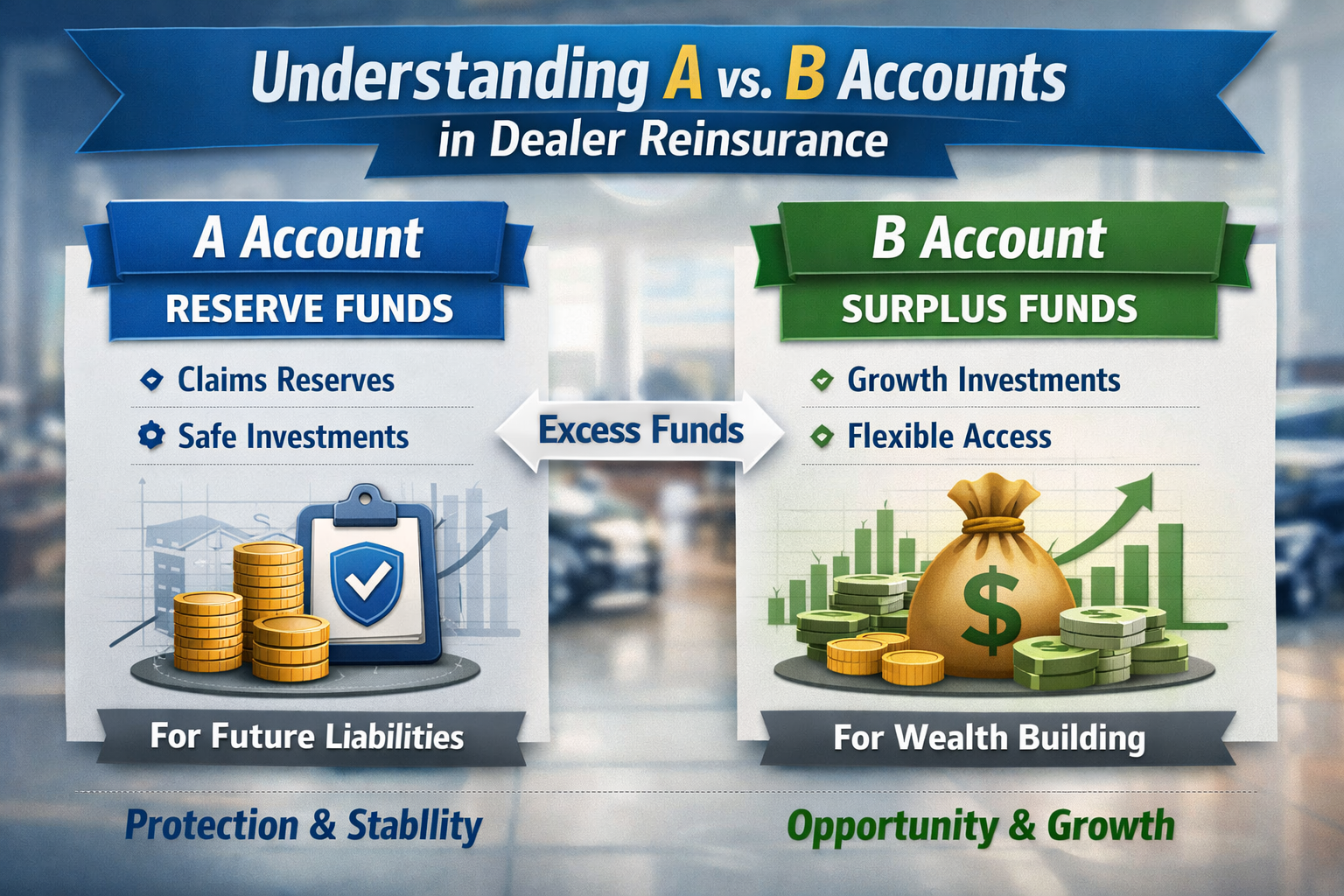
Dealer reinsurance is one of the most powerful long-term wealth strategies available to a dealership, and it is also one of the least understood. Owners hear the headline, that they can participate in the underwriting profit and investment income of the F&I products they already sell, but very few can explain how a dollar of premium actually travels from a customer’s deal into their own trust account, and when it becomes theirs to use.
That gap matters. The trust account is where the entire strategy lives or dies. Understanding how it works is what lets a dealer evaluate transparency, judge reserve health, separate real surplus from money that is still spoken for, and hold a provider accountable. This guide walks through the full mechanics: A Accounts and B Accounts, reserve timing and release, IBNR, how to read each line of a statement, and the questions every owner should be asking.
Why the Trust Account Is the Financial Heart of Dealer Reinsurance
When a customer buys an F&I product, the premium does not vanish into the administrator. In a reinsurance arrangement, a defined portion of that premium is ceded to the dealer’s own reinsurance company and held in a trust account, where it backs future claims and, over time, grows into surplus the dealer can access. The trust account is the ledger that tracks all of it.
Several flows run through that account, and a dealer should understand each one. Premium comes in from the products sold. The administrator retains a portion and pays a ceding fee to move the risk into the reinsurance company. A claims reserve is set aside to pay covered claims as they happen. The remaining trust assets earn investment income. As contracts age and exposure ends, reserves are released and accumulate as surplus, which becomes the basis for distributions to the dealer. If you do not understand how funds move through these stages, you cannot tell whether a program is performing or simply looks good on a summary page.
How Dealer Reinsurance Money Flows
At a high level, a dollar of premium follows a consistent path from the showroom to the dealer’s surplus. The flow below shows the journey, and the rest of this article explains what happens at each step.
- Dealer sells an F&I product
- Administrator collects the premium
- Ceding fee retained by the administrator
- Net premium ceded to the dealer reinsurance company
- Held in the trust account
- A Account holds required claims reserves
- Reserves release as contracts mature
- B Account accumulates surplus and investment growth
- Distributions to the dealer
Two ideas from that diagram are worth holding onto. First, not every dollar in the trust is available, because a large share is held as reserves against claims that have not happened yet. Second, money becomes accessible over time as exposure winds down, which is why timing is as important as totals.
Understanding A Accounts and B Accounts
Most dealer reinsurance trust structures separate funds into two buckets, commonly called the A Account and the B Account. The names vary by administrator, but the function is consistent: one holds the money that must stand behind active claims exposure, and the other holds the money that has earned its way free.
The A Account holds required reserves. These are restricted assets, set aside to pay claims on contracts that are still in force. Because the exposure is active, the A Account is not freely accessible, and its primary investment role is to safely back those reserves. The B Account holds surplus: funds from contracts that have matured, where the claims exposure has largely run off. The B Account is where long-term investment growth compounds, and it is the bucket from which distributions are generally made, subject to the program’s structure and rules.
| Feature | A Account | B Account |
|---|---|---|
| Purpose | Required reserves | Surplus |
| Claims exposure | Active | Mature |
| Accessibility | Restricted | Generally available, subject to structure |
| Investment role | Reserve backing | Long-term growth |
| Distribution eligibility | Limited | Often eligible |
| Liquidity | Lower, held for claims | Higher, as surplus matures |
The practical takeaway: a healthy program is not the one with the largest A Account. A large A Account simply means significant active exposure. Real, usable wealth shows up as a growing B Account, which reflects business that has aged, paid its claims, and released its reserves.
What Is IBNR?
IBNR stands for Incurred But Not Reported. It is the actuary’s estimate of claims that have already happened but have not yet been filed, processed, or fully paid. A customer’s covered failure on the last day of a month may not reach the administrator for weeks, yet the obligation already exists. IBNR makes sure the trust holds money for those claims even before they appear on paper.
Actuaries use IBNR because claims reporting always lags the event. Without it, a trust would look healthier than it really is, and reserves would be set too low. IBNR raises required reserves to reflect the true, fully-developed cost of the exposure, which protects both the customer and the dealer from an under-reserved program that later has to claw money back.
Dealers should monitor IBNR because it directly affects how much of the trust is genuinely free. A common misconception is that IBNR is a fee or a deduction the provider keeps. It is not. It is a reserve estimate that stays in the trust to pay future claims. On a statement, IBNR typically appears as a component of incurred claims or required reserves. If a provider cannot show you how IBNR is calculated, that is a transparency problem worth pressing on.
Reserve Timing: When Does Money Become Available?
Reserves are not released on a calendar. They are released as risk runs off. Understanding that lifecycle is the difference between expecting a distribution that is not available yet and recognizing surplus that has genuinely matured. Consider a typical 36-month contract:
- Month 1 · Contract written, reserve set high
- Month 12 · Claims activity begins, reserve still substantial
- Month 24 · Exposure declining, reserve drawing down
- Month 36 · Exposure ends, remaining reserve released
- Released reserve becomes surplus
Early in the contract, almost the entire premium sits in reserve because the full term of risk is still ahead. As months pass and claims are paid, the reserve required for that contract declines. When the term ends and exposure is gone, the remaining reserve is released and moves toward surplus. Multiply this across thousands of contracts written in different months and you get a trust that is always holding a mix of young, high-reserve business and mature, releasing business. That mix, not the headline balance, is what determines how much is truly available.
How to Read Your Dealer Reinsurance Statement
A trust statement is only useful if you understand what each line represents. The items below appear on most statements. For each, here is what it means, why it matters, and what to watch for.
Premium Written
The total premium ceded into the reinsurance company for the period. It reflects production volume. Watch for unexplained drops, which can signal slipping penetration or a product falling off the menu.
Ceding Fees
The amount retained by the administrator to move the risk into your company. It is a real cost of the program. Ask how it is calculated and whether it is fixed or variable, and compare it across providers, because fee structures differ widely.
Claims Paid
Claims actually disbursed during the period. This is your loss experience in cash terms. A sudden spike deserves a look at product mix and claims practices.
Claims Incurred
Claims paid plus the change in reserves for claims already known, often including IBNR. It is a truer measure of loss cost than paid claims alone, because it reflects obligations that exist even if the check has not gone out.
IBNR
The reserve for claims incurred but not yet reported. It keeps the trust honest about future obligations. Confirm it is being estimated by a qualified actuary and ask to see the methodology.
Required Reserves
The total that must be held to back active exposure. This is the money that is not yet yours. A rising required-reserve figure usually means growing, younger business, not a problem.
A Account Balance
The restricted reserve bucket. Large is not inherently good; it reflects active exposure. Track it against incurred claims to judge whether reserves are adequate, not just large.
B Account Balance
The surplus bucket. This is the figure most closely tied to accessible, accumulated wealth. Steady growth here over time is the sign of a maturing, healthy program.
Investment Earnings
Income earned on trust assets. Over a long horizon, investment income is a meaningful part of the return. Ask how assets are invested and who manages them.
Administrative Fees
Ongoing costs charged to operate the company and trust. Understand every fee and how it is applied. Unexplained or layered fees are a common transparency issue. Our breakdown in Reinsurance Fees Decoded covers what statements often leave out.
Surplus
Assets above required reserves. Surplus is the engine of distributions and long-term wealth. Watch the trend, not a single month.
Net Assets
Total trust assets after liabilities and reserves. It is the bottom-line picture, but it must be read alongside reserve timing, because a healthy net-assets figure can still include money that is not yet available.
Scan these first
On any monthly statement, start with three lines: the B Account balance (is accessible surplus growing?), incurred claims including IBNR (is loss cost stable?), and total fees (do you understand every one?). Those three, tracked over time, tell you more than the headline total ever will.
Seven Common Mistakes Dealers Make Reading Trust Statements
- Thinking all trust assets are available. A large share is reserved against active claims and is not yours to take yet.
- Ignoring reserve timing. Money becomes available as exposure runs off, not on a fixed schedule.
- Looking only at total assets. The headline balance blends restricted reserves and free surplus into one misleading number.
- Ignoring IBNR. Skipping the reserve for unreported claims makes a program look healthier than it is.
- Overlooking investment performance. Over a long horizon, investment income is a real part of the return and deserves scrutiny.
- Never reviewing reserve methodology. If you do not know how reserves are set, you cannot judge whether they are right.
- Failing to compare statements over time. Trends reveal health. A single month tells you almost nothing.
How Different Reinsurance Structures Affect Trust Accounts
The structure you choose changes how reserves are held, how distributions work, and how much flexibility and control you have. The right fit depends on volume, goals, and risk tolerance, and you can weigh them with our reinsurance comparison tool or the overview of program structures.
A Retro program shares profit without forming a company, which lowers the barrier to entry but offers less control over reserves and investments. A CFC (controlled foreign corporation) is a dealer-owned company that gives the owner control over the trust, reserves, and investment approach. A Super CFC extends that model, and an NCFC offers a non-controlled variation suited to different ownership situations. A DOWC (dealer-owned warranty company) changes the tax and accounting profile and can offer earlier access to underwriting profit. Each structure carries different reserve timing, distribution rules, and reporting, which is exactly why the trust account behaves differently under each. None of this is tax, legal, or investment advice; the right structure should be chosen with qualified advisors. Start with the basics of dealer reinsurance if these terms are new.
Why Product Mix Changes Reserve Performance
Not all F&I products behave the same way inside a trust, because they have different claims patterns. The mix you write shapes how reserves build and release over time.
Vehicle service contracts are the primary input for most programs, with claims spread across a multi-year term, which produces a steady, predictable reserve curve. GAP has a different shape, with total-loss claims that cluster differently than mechanical repairs. Appearance protection and tire and wheel tend to have higher frequency but lower severity, while Deposit Protect has low, stable frequency tied to total-loss events. A trust weighted toward one product will reserve and release differently than a balanced one. A thoughtful, well-presented product strategy, covered in our guide to the best F&I products for auto dealers, is what gives the trust a healthy, diversified claims profile over time.
Questions Every Dealer Should Ask Their Provider
Transparency is something you can test. A strong provider answers these readily, and a vague answer is itself useful information.
- How are reserves calculated, and what assumptions drive them?
- Who performs the actuarial analysis, and what are their credentials?
- How often are reserves updated and trued up?
- Can I see the reserve methodology in writing?
- How are trust investments managed, and who manages them?
- How are all fees calculated and applied?
- How are distributions determined, and when?
- What reports should I receive every month, and what is on them?
For a deeper, line-by-line review, our dealer reinsurance audit checklist walks through fees, claims, and net premium the way an owner should.
How Elite FI Partners Evaluates Dealer Reinsurance Programs
We review programs the way an owner would if they had the time and the actuarial fluency. That means looking past the sales presentation and the pro forma at how the program actually performs, a gap we explore in Pro Forma vs Reality.
A complete review covers the structure and whether it fits the store, the transparency of reporting, a line-by-line statement review, the reserve methodology and who stands behind it, real claims performance, administrator quality, the training that drives consistent production, the product mix feeding the trust, and a full fee analysis. The goal is a clear, honest picture of where a program stands and what it should produce, grounded in the actual numbers rather than projections. You can read more about our approach to reinsurance transparency or compare paths in our guide to choosing the right reinsurance program.
Take Control of Your Dealer Reinsurance Program
Dealer reinsurance builds real, lasting wealth, but only for owners who understand and monitor the trust account behind it. Transparency, control, and understanding are not luxuries here. They are the difference between a program that quietly compounds in your favor and one that looks fine on a summary page while money sits where you cannot see it clearly. Read your statements on a regular cadence, track the trends, and ask the hard questions.
If you want a clear, confidential read on where your program stands, Elite FI Partners will review your structure, statements, reserves, and fees and give you an honest assessment. Request a confidential program review, or start with the dealer reinsurance overview to see how the pieces fit together.
Frequently Asked Questions
What is an A Account?
The A Account is the restricted bucket in a dealer reinsurance trust that holds required reserves against active claims exposure. Because those contracts are still in force, the A Account is generally not freely accessible and exists to safely back future claims.
What is a B Account?
The B Account holds surplus from contracts that have matured and released their reserves. It is where long-term investment growth compounds and is typically the bucket from which distributions are made, subject to the program structure.
What is IBNR?
IBNR means Incurred But Not Reported. It is an actuarial reserve for claims that have already happened but have not yet been filed or fully processed, ensuring the trust holds money for obligations that exist before they appear on paper.
Why are reserves required?
Reserves guarantee that money is available to pay covered claims for the full life of every contract. They protect the customer and the dealer, and they keep the program solvent and compliant rather than over-distributing money that is still needed.
How are reserves calculated?
Reserves are set by actuarial analysis based on the product, the term, expected claims frequency and severity, and reporting lag (IBNR). A qualified provider can show the methodology and updates it as claims experience develops.
When are reserves released?
Reserves release as exposure runs off. As contracts age and claims are paid, the reserve required for that business declines, and when a term ends the remaining reserve is released toward surplus. It follows the risk, not a fixed calendar.
Can reserve balances increase?
Yes. Writing more new business, or business with longer terms, raises required reserves because there is more active exposure. A rising reserve balance often reflects growth rather than a problem.
What determines surplus?
Surplus is what remains after required reserves: premium that has earned out, plus investment income, minus claims and fees. It grows as business matures and reserves release, and it is the basis for distributions.
Who owns the trust assets?
In a dealer-owned structure, the dealer’s reinsurance company owns the trust assets, subject to the reserve requirements and the rules of the structure. The exact ownership and access depend on whether the program is a Retro, CFC, NCFC, or DOWC.
How often should trust statements be reviewed?
At least monthly for the key figures, and in depth at least quarterly. Trends across statements reveal far more than any single month, so consistent review is what surfaces problems early.
What should be included on a monthly statement?
Premium written, ceding fees, claims paid and incurred, IBNR, required reserves, A and B account balances, investment earnings, administrative fees, surplus, and net assets. If any of these are missing, ask why.
How do different reinsurance structures affect reserves?
Structure changes reserve timing, distribution rules, investment control, and reporting. A Retro shares profit with less control, while a CFC, Super CFC, NCFC, or DOWC gives the dealer more ownership and flexibility, which is why the trust behaves differently under each.
Part of our guide to dealer reinsurance structures.