Building The Vision · Automotive
F&I PVR Declining? What Top Dealers Do Differently
F&I PVR is under pressure in 2026. Learn what the national average F&I PVR looks like now and how elite dealers protect and grow per-vehicle profit.
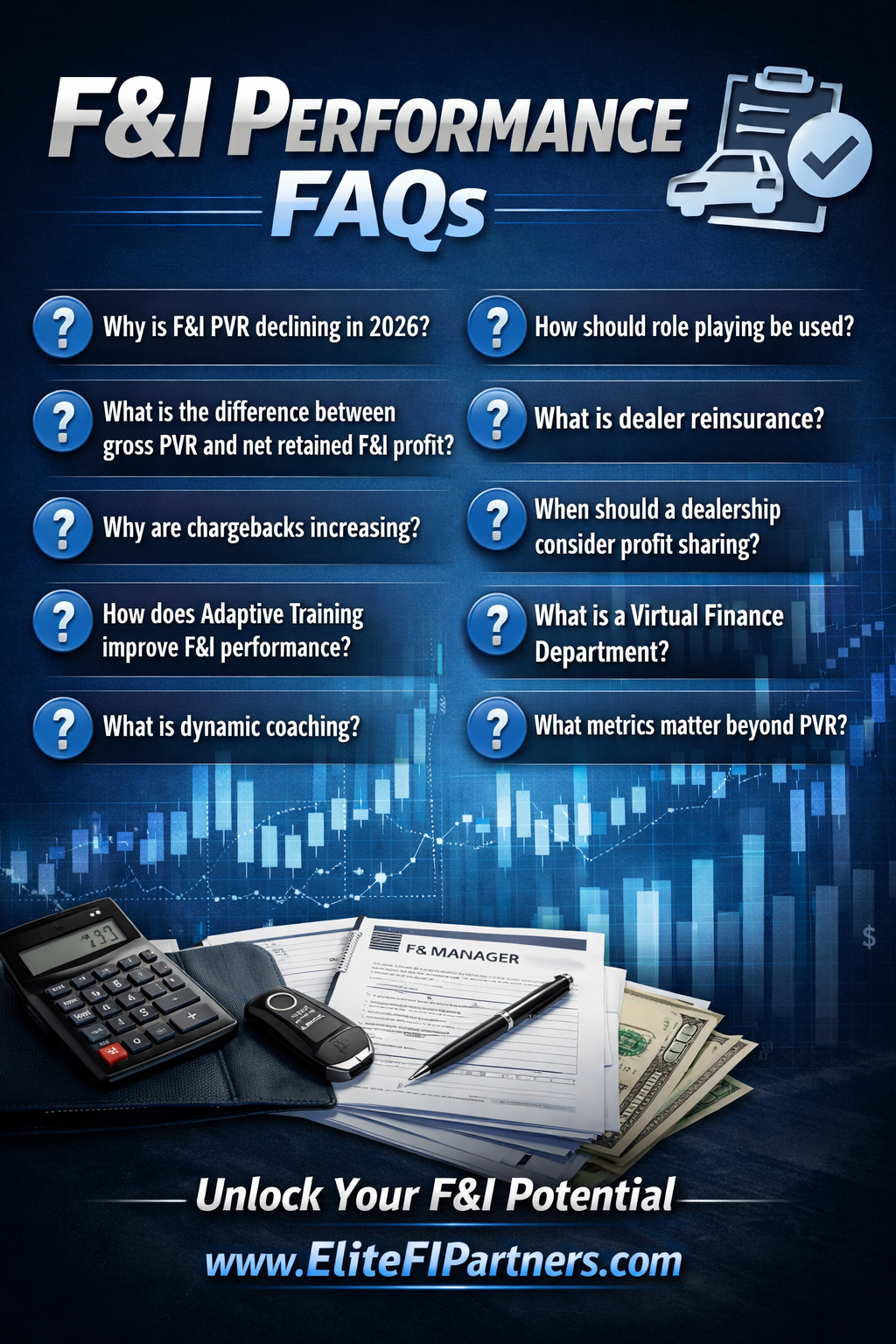
What F&I PVR actually looks like now
The decline is not subtle. Across the industry, F&I PVR averages have fallen from roughly $2,000–$2,500 per copy to as low as $1,000–$1,200 at many dealerships. That is not a rounding error in a good month; it is a structural reset in what the finance office contributes per unit.
The cause is easier to see in hindsight. Through the peak of the COVID-era market, holding high F&I numbers took very little skill — unprecedented demand did the work. Stores came to rely on market conditions rather than process, and when the market normalised, a lot of finance departments discovered they had no repeatable method underneath the results. The stores that held their PVR were the ones whose numbers were never coming from the market in the first place.
That is the backdrop for everything below: what is actually eroding the number today, what PVR hides once chargebacks and affordability are accounted for, and what the strongest stores are doing differently.
For much of the past decade, dealership F&I performance was judged almost exclusively by Profit Per Vehicle Retailed (PVR). If the number was strong, the department was considered successful. If it dipped, pressure increased, scripts were rewritten, and training was blamed. In 2026, that approach is no longer sufficient.
While reported F&I PVR averages appear stable on paper, many dealerships are experiencing a very different reality behind the scenes. Rising chargebacks, increased cancellations, heightened payment sensitivity, and shrinking retained earnings have created an illusion of performance. Monthly statements may look healthy, but long-term profitability is quietly eroding. The dealers outperforming today are no longer managing F&I as a transactional function. They are managing it as a long-term wealth strategy, built on adaptive training, disciplined process, dynamic coaching, and profit sharing.
The Problem With Using PVR as the Primary F&I Metric
PVR measures what happens at the moment of sale, but it fails to account for what happens after the customer leaves the dealership. In today’s market, that distinction matters more than ever.
Interest rate volatility, extended loan terms, and aggressive refinancing campaigns have created an environment where a significant percentage of F&I contracts never reach maturity. When products cancel early, chargebacks follow, and profit that once appeared earned disappears months later. This creates unpredictable cash flow, unreliable forecasting, and compensation structures that reward short-term behavior over long-term retention.
Elite dealers are shifting away from gross PVR and focusing instead on net retained F&I profit, recognizing that a contract that sticks is far more valuable than one that maximizes markup but cancels.
How the Post-COVID Market Exposed Weak F&I Fundamentals
During the inventory-constrained years, many dealerships did not need elite execution to post strong F&I numbers. Demand exceeded supply, customers accepted unfavorable terms, and protection products sold with limited resistance. That environment masked structural weaknesses and created dependence on market conditions rather than skill.
As affordability pressure returned and inventory normalized, many finance teams discovered they were overly reliant on scripted word tracks, outdated closing techniques, and payment-focused selling strategies that no longer align with the modern buyer. The decline in F&I performance is not a talent issue. It is a training and process issue.
Why Traditional F&I Training No Longer Works
Most legacy finance manager training programs were built for a different customer and a different market. They emphasized memorization over mastery, rebuttals over understanding, and rigid scripts over adaptability. In 2026, customers can identify scripted selling almost immediately, and resistance follows.
Modern F&I success requires the ability to read customers in real time, adjust pacing and depth based on behavioral cues, and explain product value in a consultative way. This shift is the foundation of Adaptive Training, which is central to Elite FI Partners’ approach to dealership growth.
Learn more about our approach to training and dealer support at
👉 https://www.elitefipartners.com
Adaptive Training: Process Driven by Dynamics, Not Scripts
Adaptive Training replaces rigid word tracks with process mastery. The objective is not to memorize the “right” line but to understand why a customer is hesitating and respond with clarity and confidence.
Building Consistency Without Robotic Delivery
Adaptive Training provides a consistent structure for menu presentation and customer engagement while allowing flexibility in delivery. Finance managers learn to identify customer motivation, payment sensitivity, and risk tolerance early in the conversation, then guide the process accordingly.
This dynamic approach improves F&I product penetration, customer satisfaction, and contract retention, while creating repeatable performance across the entire finance team.
Dynamic Coaching and Role Playing That Drives Results
One-time training events fail because performance erodes without reinforcement. High-performing dealerships invest in ongoing dynamic coaching, supported by role playing that reflects real customer scenarios rather than canned objections.
Role Playing Based on Real Buyer Behavior
Effective role playing prepares finance managers to handle payment-driven buyers, high-interest-rate objections, refinancing concerns, cash buyers, and technology-focused customers. Instead of rehearsing scripts, managers practice decision-making and adaptability.
This coaching model builds confidence, reduces friction, and creates consistency—especially in volatile market conditions.
Redefining the Role of the Finance Manager in 2026
In today’s market, the finance manager is no longer just a product presenter or closer. They are a risk translator for the customer and a wealth architect for the dealership.
When finance managers understand that success is tied to contract longevity, customer usage, and long-term program performance, behavior changes. Product recommendations become more relevant, pressure decreases, and cancellations decline. This alignment is critical for stabilizing F&I results and reducing chargebacks.
Profit Sharing and Dealer Reinsurance as a Long-Term Strategy
One of the most overlooked questions in F&I is where the profit goes. Dealer reinsurance and profit-sharing strategies allow dealerships to participate in underwriting profit and investment income rather than surrendering it entirely to third parties.
When structured correctly, reinsurance helps dealerships stabilize earnings, reduce dependence on volatile month-to-month PVR, and build compounding wealth over time. Elite dealers evaluate performance through a feature-film lens, tracking contract retention and reserve growth instead of relying solely on snapshot metrics.
You can explore Elite FI Partners’ dealer wealth and profit-sharing approach here:
👉 https://www.elitefipartners.com/dealer-wealth-programs
Virtual F&I and the Modern Dealership Experience
Virtual finance is no longer a temporary solution. It has become a permanent part of the modern dealership model. When supported by adaptive training and disciplined process, a Virtual Finance Department can deliver consistent performance without sacrificing customer experience.
Finance managers trained in dynamic communication perform effectively through virtual channels, particularly with payment-sensitive or time-constrained buyers. Virtual F&I is not a shortcut—it is a strategic extension of a well-run finance operation.
Learn more about Elite FI Partners’ Virtual Finance Department here:
👉 https://www.elitefipartners.com/the-virtual-finance-department
The Path Forward for Dealerships Focused on Sustainable Growth
The decline in F&I PVR is not a crisis. It is a signal that old training models no longer fit, short-term metrics are insufficient, and retention matters more than ever.
Dealerships that respond with adaptive training, dynamic coaching, disciplined F&I process, and profit-sharing strategy will not just recover—they will outperform. Sustainable profitability is built after the sale, not just at it.
If your dealership is ready to rethink F&I performance and build a model designed for 2026 and beyond, Elite FI Partners helps dealers strengthen execution, improve retention, and create long-term profitability through training, process, and strategy built around real-world dynamics.
FAQ
Why is F&I PVR declining in 2026?
In many dealerships, gross F&I PVR isn’t truly “down”—it’s becoming less reliable due to rising chargebacks, cancellations, payment sensitivity, and refinancing activity that erodes retained profit after the sale.
What is the difference between gross PVR and net retained F&I profit?
Gross PVR reflects profit booked at the time of sale. Net retained F&I profit accounts for what actually sticks after cancellations, chargebacks, and true-ups—making it a better indicator of sustainable dealership profitability.
Why are chargebacks increasing and what is causing them?
Chargebacks increase when customers refinance, cancel products, or unwind contracts early. Higher interest rates and “rate shopping” can trigger refinancing campaigns that lead to pro-rata cancellations and commission reversals.
How does Adaptive Training improve F&I performance?
Adaptive Training improves F&I performance by focusing on process mastery and customer dynamics rather than scripts. It helps finance teams deliver consistent menu presentations while adapting to different buyer types and objections in real time.
What is dynamic coaching and why is it more effective than one-time training?
Dynamic coaching is ongoing, real-world coaching that reinforces skills over time. It is more effective than one-time training because it builds repeatable habits, improves consistency across the team, and prevents performance drop-off.
How should role playing be used to increase product penetration?
Role playing should mirror real customer scenarios—payment shoppers, high-rate objections, refinance concerns, cash buyers, and tech-focused customers—so finance managers practice decision-making, pacing, and value-based communication.
What is dealer reinsurance and how does it connect to F&I products?
Dealer reinsurance is a profit-sharing strategy that allows a dealership to participate in underwriting profit and investment income tied to eligible F&I products. It connects F&I performance to long-term wealth creation.
When should a dealership consider profit sharing or reinsurance?
A dealership should consider profit sharing or reinsurance once it has consistent F&I product volume, stable performance, and the operational discipline to support retention. A pro forma analysis helps determine readiness and fit.
What is a Virtual Finance Department and who benefits most from it?
A Virtual Finance Department is a structured model for delivering F&I remotely or with centralized support. It benefits dealerships needing staffing flexibility, multi-store consistency, expanded coverage hours, and improved process control.
What are the most important metrics to track in addition to PVR?
Beyond PVR, dealerships should track product penetration, cancellation rate, chargeback rate, net retained profit, customer satisfaction, service retention, and reinsurance reserve growth (when applicable).
Related reading: Boosting PVR in 2026: The F&I Products and Strategies Driving Dealership Profitability